
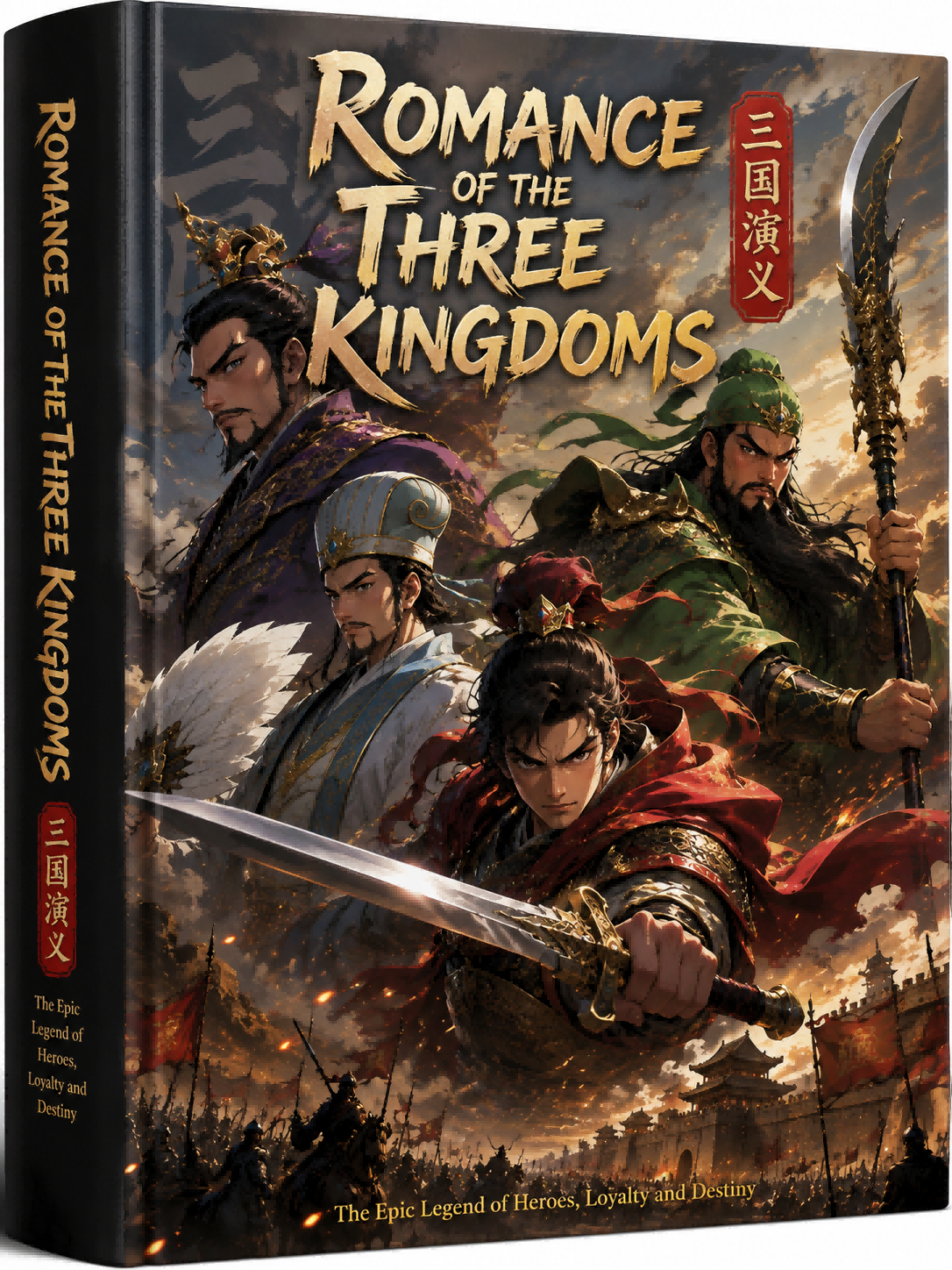
Chapter Five: Cao Cao Issues a Forged Imperial Edict and the Regional Lords Rally to His Call; Three Heroes Battle Lü Bu at the Pass.
Cao Cao issued a forged imperial edict, summoning the regional lords to join forces against Dong Zhuo. Guan Yu, Zhang Fei, and Liu Bei—the Three Heroes—fought Lü Bu in a legendary battle at Hulao Pass. The assembled heroes, united in a righteous cause, displayed the full measure of valor and heroic spirit that would come to define the age of the Three Kingdoms.
Now, Chen Gong was just about to act on his impulse and kill Cao Cao, when he suddenly had a change of heart and thought: "I followed him here for the sake of the state. To kill him now would be unjust. It would be better to abandon him and go elsewhere." So he sheathed his sword, mounted his horse, and before dawn broke, he departed for Dong Commandery.
When Cao Cao awoke and found Chen Gong gone, he reasoned: "He must have taken my words to heart, suspected me of being unrighteous, and left me. I must hurry—I cannot stay here long." He then traveled through the night to Chenliu, where he found his father and told him everything that had happened. He proposed to use the family fortune to recruit volunteer troops. His father said, "Our means are too meager—we may not succeed. There is a Filial and Incorrupt man here named Wei Hong, who is generous with his wealth and upholds righteousness. His family is enormously wealthy. If we can secure his help, our enterprise may be achieved."
Cao Cao then prepared a banquet and invited Wei Hong to his home. Bowing, he said, "Now the Han house has no true sovereign; Dong Zhuo has usurped power, deceived the sovereign, and oppressed the people—all under heaven gnash their teeth in hatred. I wish to exert myself to support the state, but I regret that my strength is insufficient. You, sir, are a man of loyalty and righteousness—I dare to beg for your assistance!" Wei Hong replied, "I have long cherished such a wish, but I regretted only that I had not met a hero. Since you, Mengde, have such great ambition, I am willing to contribute my family fortune to your cause." Cao Cao was overjoyed.
He first issued a forged imperial edict and dispatched it swiftly to all the provinces. Then he gathered volunteer troops and raised a white banner bearing the two words "Loyalty and Righteousness." Within a few days, those who came to enlist gathered like rain.
One day, a man from Yangping in the State of Wei—surnamed Yue, given name Jin, and courtesy name Wenqian—came to join Cao Cao. Another man, from Julu in Shanyang—surnamed Li, given name Dian, and courtesy name Mancheng—also came to join Cao Cao. Cao Cao kept them both as clerks under his command. Then came Xiahou Dun, courtesy name Yuanrang, from Qiao in the State of Pei—a descendant of Xiahou Ying. From childhood he had practiced with spear and staff; at fourteen he studied martial arts under a master. When someone insulted his teacher, Xiahou Dun killed the man and fled to distant lands. Hearing that Cao Cao had raised troops, he came with his younger cousin Xiahou Yuan, each leading a thousand brave men to join the cause. These two were actually brothers of Cao Cao by blood: Cao Cao's father, Cao Song, was originally a son of the Xiahou clan, adopted into the Cao family—so they were of the same clan.
Within a few days, the Cao brothers—Cao Ren and Cao Hong—each led over a thousand troops to assist him. Cao Ren, courtesy name Zixiao, and Cao Hong, courtesy name Zilian, were both skilled in archery and horsemanship, and proficient in the martial arts. Cao Cao was overjoyed and drilled his troops in the village. Wei Hong contributed his entire family fortune to equip them with armor, clothing, banners, and flags. Those who sent grain from all directions were beyond count.
At that time, Yuan Shao, having received Cao Cao's forged imperial edict, gathered his civil and military officers, led thirty thousand troops, and left Bohai to form an alliance with Cao Cao. Cao Cao then issued a proclamation to all the commanderies. The proclamation read:
"Cao Cao and his allies solemnly declare to all under heaven: Dong Zhuo has defied Heaven and violated Earth, extinguished states and slain sovereigns; he has debauched the imperial palace and cruelly harmed the people; he is savage and unrighteous, and his crimes are heaped to the full! We now hold a secret edict from the Son of Heaven and have gathered righteous troops, vowing to cleanse this land and exterminate the horde of villains. We look to you to raise righteous armies and join us in venting the common outrage; to support the royal house and save the common people. Upon the day this proclamation reaches you, act swiftly without delay!"
After Cao Cao sent out the proclamation, the regional lords of all the provinces raised troops in response:
First Contingent: Yuan Shu, General of the Rear and Governor of Nanyang.
Second Contingent: Han Fu, Inspector of Ji Province.
Third Contingent: Kong Zhou, Inspector of Yu Province.
Fourth Contingent: Liu Dai, Inspector of Yan Province.
Fifth Contingent: Wang Kuang, Governor of Henei Commandery.
Sixth Contingent: Zhang Miao, Governor of Chenliu.
Seventh Contingent: Qiao Mao, Governor of Dong Commandery.
Eighth Contingent: Yuan Yi, Governor of Shanyang.
Ninth Contingent: Bao Xin, Chancellor of Jibei.
Tenth Contingent: Kong Rong, Governor of Beihai.
Eleventh Contingent: Zhang Chao, Governor of Guangling.
Twelfth Contingent: Tao Qian, Inspector of Xu Province.
Thirteenth Contingent: Ma Teng, Inspector of Liangzhou.
Fourteenth Contingent: Gongsun Zan, Governor of Beiping.
Fifteenth Contingent: Zhang Yang, Governor of Shangdang.
Sixteenth Contingent: Sun Jian, Marquis of Wucheng and Governor of Changsha.
Seventeenth Contingent: Yuan Shao, Marquis of Qixiang and Governor of Bohai.
The various regional forces varied in size—some had thirty thousand troops, others twelve thousand—each led by their civil and military officers, all marching toward Luoyang.
Now, Gongsun Zan, the Governor of Beiping, was leading fifteen thousand elite troops and passing through Pingyuan County in Dezhou. As they were marching, he saw from a distance, amid a grove of mulberry trees, a yellow banner and several riders coming forward to greet him. Gongsun Zan looked and saw that it was Liu Bei. Gongsun Zan asked, "Worthy brother, why are you here?" Liu Bei replied, "In former days, thanks to your recommendation, I was appointed Magistrate of Pingyuan County. Now, hearing that your great army was passing by, I came to pay my respects and to invite you into the city to rest your horses." Gongsun Zan pointed to Guan Yu and Zhang Fei and asked, "Who are these men?" Liu Bei said, "These are Guan Yu and Zhang Fei, my sworn brothers." Gongsun Zan said, "Are they the ones who helped you defeat the Yellow Turbans?" Liu Bei replied, "It was all thanks to these two men." Gongsun Zan asked, "What posts do they hold now?" Liu Bei answered, "Guan Yu serves as a mounted archer, and Zhang Fei as a foot archer." Gongsun Zan sighed and said, "To think that such heroes are so buried! Now Dong Zhuo is stirring up chaos, and all the regional lords of the realm are joining together to destroy him. Worthy brother, you should abandon this lowly post and join us in punishing the traitor, to uphold the Han house—what do you say?" Liu Bei said, "I am willing to go." Zhang Fei said, "If you had allowed me to kill that villain back then, we would have been spared today's troubles." Guan Yu said, "Since matters have come to this, we must gather our things and go at once."
Liu Bei, with Guan Yu and Zhang Fei and a few riders, followed Gongsun Zan. Cao Cao came out to receive them. The various regional lords also arrived one after another, each setting up camp and encampments, which stretched for over two hundred li in a continuous line. Cao Cao then slaughtered oxen and horses and held a great assembly of the regional lords to discuss the plan of advance. Wang Kuang, the Governor of Henei, said, "Now that we are acting in the cause of righteousness, we must first choose an alliance leader, so that all may obey the same commands before we advance." Cao Cao said, "Yuan Shao has held high office for four generations and is a descendant of a famous chancellor of the Han house; he has many former subordinates among the officials. He is fit to be the alliance leader." Yuan Shao repeatedly declined, but the others all said that none but Yuan Shao could fill the role, so he finally agreed.
The next day, a three‑tier altar was built, with banners of the five directions arrayed on all sides. Above it were raised a white yak‑tail standard and a yellow axe, along with military tally‑tokens and general's seals. Yuan Shao was invited to ascend the altar. He straightened his robes, girded his sword, and ascended with a solemn air. He burned incense and bowed twice. His oath read:
"The Han house is unfortunate—the imperial order has lost its rightful course. The traitorous minister Dong Zhuo, seizing upon strife, has wrought havoc, bringing calamity upon the sovereign and misery upon the people. We, Yuan Shao and the others, fearing that the state shall perish, have gathered righteous troops and come together to face the nation's crisis. All who join this covenant shall be of one heart and one strength, upholding the duty of a minister, without any divided purpose. Should anyone violate this oath, may he lose his life and leave no descendants. May Heaven above, Earth below, and the enlightened spirits of our ancestors truly bear witness to this!"
When the reading was finished, they smeared their lips with blood. Moved by the impassioned tone of the words, all wept with tears streaming down their faces. After the blood oath was completed, they descended from the altar. They supported Yuan Shao to ascend to the command tent, where the assembly was seated on both sides according to rank and age. Cao Cao poured wine and made several rounds, then said, "Now that we have established our alliance leader, each shall obey his commands, and together we shall support the state. Let no one dispute based on strength or weakness." Yuan Shao said, "Although I am of little ability, since you have seen fit to make me your leader, merit shall be rewarded, and transgressions punished. The state has its fixed penalties, and the army its discipline. Each must abide by these rules, and none shall violate them." All present replied, "We follow your commands." Yuan Shao then said, "My younger brother Yuan Shu shall be in charge of provisions and supplies, ensuring that all camps are adequately provided and nothing is lacking. Moreover, we need one man to lead the vanguard, to ride directly to Sishui Pass and challenge the enemy. The rest of you shall hold the strategic points to provide support."
Sun Jian, the Governor of Changsha, stepped forward and said, "I am willing to lead the vanguard." Yuan Shao said, "Wentai is brave and fierce—he is well suited for this task." Sun Jian then led his own troops and marched straight toward Sishui Pass. The defending officers at the pass sent a swift rider bearing an urgent dispatch to the Chancellor's residence in Luoyang. Since seizing sole power, Dong Zhuo had spent his days feasting and drinking. Li Ru, upon receiving the urgent dispatch, went directly to report it to Dong Zhuo. Dong Zhuo was greatly alarmed and hastily summoned his generals for discussion.
Lü Bu, the Marquis of Wen, stepped forward and said, "Father, do not worry. I regard the lords beyond the pass as no more than weeds. I am willing to lead our fierce troops, cut off all their heads, and hang them at the city gates." Dong Zhuo was overjoyed and said, "With Fengxian by my side, I can rest easy!" Before he had finished speaking, a man behind Lü Bu called out loudly, "Why use a butcher's knife to kill a chicken? There is no need for the Marquis of Wen to go in person. I can cut off the heads of those regional lords as easily as taking something from a bag!" Dong Zhuo looked and saw a man nine feet tall, with a tiger's body and wolf's waist, a leopard's head and ape's arms—a man from west of the passes, surnamed Hua, given name Xiong. Dong Zhuo was overjoyed at his words and appointed him Colonel of the Swift Cavalry. He gave him fifty thousand infantry and cavalry, along with Li Su, Hu Zhen, and Zhao Cen, and ordered them to march day and night to the pass to meet the enemy.
Among the regional lords was Bao Xin, the Chancellor of Jibei. He thought to himself, "Since Sun Jian has been made the vanguard, he might steal the glory of the first victory." So he secretly sent his younger brother Bao Zhong, with three thousand infantry and cavalry, to take a shortcut and march straight to the pass to offer battle. Hua Xiong then led five hundred iron cavalry and charged down from the pass, bellowing, "Traitor general, do not flee!" Bao Zhong tried to retreat hastily, but Hua Xiong raised his blade and struck him down from his horse, capturing many officers and soldiers. Hua Xiong sent men to present Bao Zhong's head to the Chancellor's residence as a report of victory, and Dong Zhuo appointed Hua Xiong as Commander‑in‑Chief.
Now, Sun Jian led four generals straight to the pass. Who were these four? The first was Cheng Pu, courtesy name Demou, a native of Tuyin in Right Beiping, who wielded an iron‑spined serpent spear. The second was Huang Gai, courtesy name Gongfu, a native of Lingling, who wielded an iron whip. The third was Han Dang, courtesy name Yigong, a native of Lingzhi in Liaoxi, who wielded a great saber. The fourth was Zu Mao, courtesy name Darong, a native of Fuchun in Wu Commandery, who wielded twin swords. Sun Jian, clad in silver‑white armor, wearing a red turban, grasping his Guding saber, and riding a piebald horse, pointed at the pass and cursed, "You villain who aids the wicked—why not surrender at once!" Hua Xiong's deputy general Hu Zhen then led five thousand troops out of the pass to meet the attack. Cheng Pu spurred his horse, leveled his spear, and charged straight at Hu Zhen. After only a few exchanges, Cheng Pu thrust his spear into Hu Zhen's throat, and Hu Zhen fell dead from his horse. Sun Jian then waved his forces forward, advancing straight to the pass, where arrows and rocks rained down like a storm from the walls. Sun Jian withdrew his troops and encamped east of Liang, sending men to report the victory to Yuan Shao and to urge Yuan Shu for provisions.
Someone said to Yuan Shu, "Sun Jian is a fierce tiger of Jiangdong. If he breaks through Luoyang and kills Dong Zhuo, it will be like getting rid of a wolf only to gain a tiger. If we do not supply him with provisions now, his army will surely scatter." Yuan Shu heeded these words and did not send provisions. Sun Jian's army, lacking food, fell into chaos from within. Spies reported this to the pass. Li Su then devised a plan for Hua Xiong, saying, "Tonight I will lead a force down the pass by a small path and attack the rear of Sun Jian's camp, while you strike his front camp—then Sun Jian can be captured." Hua Xiong agreed and ordered his soldiers to eat their fill, then descend from the pass under cover of night.
That night, the moon was bright and the wind clear. When they reached Sun Jian's camp, it was already midnight. They raised a great clamor and charged straight in. Sun Jian, in haste, donned his armor and mounted his horse, only to come face‑to‑face with Hua Xiong. The two horses met, and they exchanged but a few blows when Li Su's forces arrived from behind and set fire everywhere. Sun Jian's troops scattered in confusion. The generals fought their way through the melee; only Zu Mao stayed close to Sun Jian and broke out of the encirclement. Behind them, Hua Xiong gave chase. Sun Jian took his bow and loosed two arrows, but Hua Xiong dodged both. As he drew a third arrow, he pulled with such force that he snapped his magpie‑painted bow. He had no choice but to abandon the bow and gallop away.
Zu Mao said, "My lord, your red turban is too conspicuous—the enemy can recognize you by it. Take it off and let me wear it." Sun Jian then removed his turban and exchanged it for Zu Mao's helmet, and the two fled in separate directions. Hua Xiong's troops pursued only the one wearing the red turban, while Sun Jian escaped by the smaller path. Zu Mao, hard pressed by Hua Xiong's pursuit, hung the red turban on a half‑burned pillar of a house and then slipped into the woods to hide. Hua Xiong's troops, seeing the red turban from afar in the moonlight, surrounded it on all sides but dared not approach. They shot arrows at it, and only then realized it was a decoy. They then advanced and took the turban. Zu Mao then charged out from behind the woods, swinging his twin swords, intending to cut down Hua Xiong. Hua Xiong let out a thunderous roar and cut Zu Mao down from his horse with a single stroke of his blade. The fighting lasted until dawn, when Hua Xiong led his troops back up the pass.
Cheng Pu, Huang Gai, and Han Dang all found their way back to Sun Jian, and they regrouped their forces and made camp. Sun Jian was deeply grieved by the loss of Zu Mao, and sent a messenger by night to report to Yuan Shao. Yuan Shao was greatly startled and said, "I never expected that Sun Wentai would be defeated by Hua Xiong!" He then assembled the regional lords for discussion. All the lords arrived, with Gongsun Zan coming last. Yuan Shao invited him into the tent and took his seat. Yuan Shao said, "The other day, General Bao's brother disobeyed orders and advanced without authorization, which cost him his life and lost us many soldiers. Now Sun Wentai has also been defeated by Hua Xiong. Our morale has been shaken—what shall we do?" The lords all remained silent.
Yuan Shao looked around and noticed three men standing behind Gongsun Zan, their appearances extraordinary, all of them wearing cold smiles. Yuan Shao asked, "Who are those men behind you, Governor Gongsun?" Gongsun Zan called Liu Bei forward and said, "This is my sworn brother from childhood, Liu Bei, the Magistrate of Pingyuan County." Cao Cao asked, "Is this the Liu Bei who defeated the Yellow Turbans?" Gongsun Zan replied, "Yes." He then had Liu Bei pay his respects. Gongsun Zan recounted Liu Bei's merits and his background in detail. Yuan Shao said, "Since he is of the imperial clan, bring him a seat." He then ordered Liu Bei to sit. Liu Bei modestly declined. Yuan Shao said, "I do not honor your title or rank—I honor you as a descendant of the imperial house." Liu Bei then took a seat at the lowest place, with Guan Yu and Zhang Fei standing behind him with folded arms.
Suddenly, a scout reported, "Hua Xiong has led his iron cavalry down from the pass. He has hung Governor Sun's red turban on a long pole and is shouting insults at our camp, challenging us to battle." Yuan Shao asked, "Who dares to go fight?" From behind Yuan Shu stepped forward a valiant general named Yu She, who said, "I am willing to go." Yuan Shao was pleased and sent Yu She out immediately. A report soon came back: "Yu She fought Hua Xiong for less than three exchanges, and was slain by Hua Xiong." The assembly was greatly shocked. Han Fu, the Governor of Ji Province, said, "I have a formidable general named Pan Feng who can behead Hua Xiong." Yuan Shao urgently ordered him to take the field. Pan Feng, wielding a great axe, mounted his horse. But in no time, a messenger galloped back with the report: "Pan Feng has also been slain by Hua Xiong." All present lost their composure.
Yuan Shao said, "What a pity that my top generals, Yan Liang and Wen Chou, are not here! If even one of them were present, what would we have to fear from Hua Xiong!" Before he had finished speaking, a man below the steps shouted out, "I am willing to go and bring Hua Xiong's head to you here in this tent!" All looked at him—a man nine feet tall, with a beard two feet long, phoenix eyes and silkworm-like eyebrows, a face the color of a dark red date, and a voice like a great bell—standing before the tent. Yuan Shao asked who he was. Gongsun Zan said, "This is Guan Yu, the younger brother of Liu Bei." Yuan Shao asked what post he held. Gongsun Zan replied, "He serves as a mounted archer under Liu Bei." Yuan Shu in the tent roared, "Do you take us lords for men without generals? A mere archer dares to speak such reckless words! Drive him out!" Cao Cao quickly stopped him, saying, "Gonglu, calm yourself. Since this man speaks with such boldness, he must have courage and ability. Let him try; if he fails, we can punish him later." Yuan Shao said, "Sending a mere archer to fight will surely make us a laughingstock to Hua Xiong." Cao Cao said, "This man's bearing is no ordinary one—how would Hua Xiong know he is an archer?" Lord Guan said, "If I fail, you may take my head." Cao Cao had a cup of warm wine poured and offered it to Lord Guan to drink before mounting his horse. Lord Guan said, "Leave the wine here—I will return shortly." He left the tent, grasped his saber, and vaulted onto his horse. The lords outside heard the drums resound from beyond the pass, and shouts rose up like the heavens collapsing and the earth caving in, mountains shaking and cliffs crumbling—they were all stunned. Just as they were about to send someone to find out what had happened, the jingling of harness bells was heard, and a horse arrived at the central camp. Lord Guan tossed Hua Xiong's head onto the ground. The wine was still warm. Later generations had a poem in his praise:
His might shook heaven and earth—foremost of all deeds!
The war drums at the camp gate rolled like thunder.
Lord Guan set down his cup and displayed his valor—
While the wine was still warm, he slew Hua Xiong.
Cao Cao was overjoyed. Just then, Zhang Fei stepped out from behind Liu Bei and shouted loudly, "My elder brother has slain Hua Xiong—why not charge straight into the pass right now and capture Dong Zhuo alive? What are we waiting for!" Yuan Shu flew into a rage and bellowed, "Even we high ministers are modest and yielding—how dare a mere soldier under a county magistrate put on such airs here! Drive them all out of the tent!" Cao Cao said, "Those who render merit should be rewarded—why should we care about rank or status?" Yuan Shu replied, "Since you gentlemen value only a county magistrate, I shall take my leave." Cao Cao said, "How can we let a single word ruin our great enterprise?" He ordered Gongsun Zan to take Liu Bei, Guan Yu, and Zhang Fei back to their camp. The officials all dispersed. Cao Cao then secretly sent someone with beef and wine to comfort the three.
Now, the defeated troops from Hua Xiong's army reported back to the pass. Li Su hurriedly wrote an urgent dispatch and sent it to Dong Zhuo. Dong Zhuo hastily summoned Li Ru, Lü Bu, and the others for discussion. Li Ru said, "We have now lost our top general Hua Xiong, and the enemy's momentum is formidable. Yuan Shao is the alliance leader, and his uncle Yuan Wei is currently Grand Tutor. If they should coordinate an attack from within and without, it would be most inconvenient. We must first eliminate him. I ask that you, Chancellor, personally lead a great army and divide our forces to attack them." Dong Zhuo agreed and summoned Li Jue and Guo Si to lead five hundred troops to surround the residence of the Grand Tutor Yuan Wei. They slaughtered everyone, young and old alike, without exception, and first sent Yuan Wei's head to the pass to be displayed as a warning.
Dong Zhuo then raised two hundred thousand troops and divided them into two routes: first, he ordered Li Jue and Guo Si to lead fifty thousand troops to hold Sishui Pass, with orders not to engage in battle; he himself would lead one hundred fifty thousand troops, together with Li Ru, Lü Bu, Fan Chou, Zhang Ji, and others, to defend Hulao Pass. This pass was fifty li from Luoyang. When the army arrived at the pass, Dong Zhuo ordered Lü Bu to lead thirty thousand troops and set up a great camp before the pass. Dong Zhuo himself took up position at the pass.
A swift scout carried this news back to Yuan Shao's camp. Yuan Shao assembled the lords for discussion. Cao Cao said, "Dong Zhuo is massing his troops at Hulao Pass, cutting off our central route. We should now send half our forces to meet him." Yuan Shao then divided the eight regional lords—Wang Kuang, Qiao Mao, Bao Xin, Yuan Yi, Kong Rong, Zhang Yang, Tao Qian, and Gongsun Zan—to advance toward Hulao Pass and engage the enemy. Cao Cao led his troops to move between them as support. The eight lords each set out with their forces.
Wang Kuang, the Governor of Henei, arrived first with his troops. Lü Bu, leading three thousand iron cavalry, galloped out to meet him. Wang Kuang drew up his forces in battle array. As he reined in his horse beneath his banner, he saw Lü Bu ride out: on his head he wore a purple-gold crown with three forks; on his body, a red brocade robe of a hundred flowers from western Sichuan; he was clad in chain armor adorned with beast-faced swallow-head ornaments, and girded with a finely crafted lion-and-leopard belt. He carried his bow and arrows, grasped his painted halberd, and rode the wind‑whistling Red Hare. Truly, it was said: "Among men, Lü Bu; among horses, the Red Hare!" Wang Kuang turned and asked, "Who dares to go forth and fight?" A general behind him spurred his horse forward, leveling his spear. Wang Kuang saw that it was Fang Yue, a famous general of Henei. The two horses met—in less than five exchanges, Lü Bu thrust his halberd and ran Fang Yue through, sending him tumbling from his horse. He then leveled his halberd and charged straight forward. Wang Kuang's army was utterly routed, scattering in all directions. Lü Bu charged east and west, slashing and killing as if he were in an empty field—no one could stand against him. Fortunately, the forces of Qiao Mao and Yuan Yi arrived to rescue Wang Kuang, and only then did Lü Bu withdraw. The three regional lords had each lost many men and horses, and retreated thirty li to make camp. Soon the other five lords also arrived. They consulted together, all agreeing that Lü Bu was a peerless hero whom no one could match.
While they were still pondering the matter, a scout reported: "Lü Bu is challenging us to battle!" The eight regional lords all mounted their horses at once. The army was divided into eight columns, and Lü Bu was positioned on the high ground. From afar, they could see Lü Bu's force, with its embroidered banners fluttering, charging first into the formation. Mu Shun, a general under Zhang Yang, the Governor of Shangdang, rode out leveling his spear to meet the challenge, but Lü Bu raised his halberd and, with a single stroke, ran him through, sending him tumbling from his horse. The entire assembly was stunned. Wu An'guo, a general under Kong Rong, the Governor of Beihai, wielded an iron hammer and charged out on horseback. Lü Bu brandished his halberd and spurred his horse to meet him. After more than ten exchanges, Lü Bu's halberd hacked off Wu An'guo's wrist. Wu An'guo dropped his hammer and fled. The troops of the eight lords rushed forward together and rescued Wu An'guo. Lü Bu then withdrew. The lords returned to camp to discuss the matter. Cao Cao said, "Lü Bu is peerless in valor. We should convene all eighteen regional lords and devise a good plan together. If we can capture Lü Bu, Dong Zhuo will be easy to eliminate."
While they were still discussing, Lü Bu again led his troops out to challenge them. The eight regional lords all rode out together. Gongsun Zan, brandishing his lance, engaged Lü Bu in personal combat. After only a few exchanges, Gongsun Zan was defeated and fled. Lü Bu spurred his Red Hare in pursuit. That horse could travel a thousand li in a day and flew like the wind. He was just about to catch up when he raised his halberd and thrust it toward Gongsun Zan's back. Just then, a general beside him—his round eyes wide open, his tiger whiskers bristling, wielding his eighteen‑foot serpent spear—galloped forward, thundering, "You thrice‑surnamed wretch, do not flee! Zhang Fei of Yan is here!" When Lü Bu saw him, he abandoned Gongsun Zan and engaged Zhang Fei in battle. Zhang Fei, summoning all his spirit, fought Lü Bu with fierce intensity. They battled for more than fifty exchanges, with neither gaining the upper hand. When Guan Yu saw this, he spurred his horse forward and, brandishing his eighty‑two‑jin Green Dragon Crescent Blade, joined the attack on Lü Bu. The three horses fought in a triangular formation. After thirty exchanges, they still could not bring Lü Bu down. Liu Bei then drew his twin swords, spurred his piebald steed, and charged in from an angle to help. The three of them surrounded Lü Bu and fought like a spinning lantern wheel. The troops of the eight lords stood spellbound, watching. Lü Bu, unable to block and parry all their blows, feigned a thrust at Liu Bei's face. Liu Bei dodged quickly. Lü Bu then broke through the gap in their formation, dragging his halberd behind him, and galloped back. The three would not let him go and spurred their horses in pursuit. The troops of the eight lords, raising a tremendous shout, charged forward together. Lü Bu's forces fled toward the pass, with Liu Bei, Guan Yu, and Zhang Fei in close pursuit. The ancients had a poem that spoke solely of the battle of the three against Lü Bu:
The Han's ordained course reached Emperors Huan and Ling—
Like the blazing red sun, it leaned toward its setting.
The traitor Dong Zhuo deposed the young sovereign;
Liu Xie, weak and timid, trembled in his dreaming.
Cao Cao sent forth his proclamation to the realm—
The lords, in righteous fury, all took up arms.
They chose Yuan Shao as their alliance leader,
Swearing to uphold the royal house and bring peace to all.
The Marquis of Wen, Lü Bu, unmatched in the world—
His heroic prowess praised across the four seas.
His silver armor shone with dragon-scale designs;
His golden crown held pheasant tails aloft.
His jeweled belt was wrought with devouring beasts;
His brocaded robe bore soaring phoenixes.
His dragon steed leaped, raising wind from the earth;
His painted halberd gleamed like autumn waters.
Who dared to face him when he rode from the pass?
The lords' hearts quaked with terror and dismay.
Then forth leaped Zhang Fei, the Yan man Yide,
His eighteen‑foot serpent spear held high.
His tiger whiskers bristled like golden threads;
His round eyes flashed with lightning's brilliant glare.
They fought fierce battle, neither winning yet—
Till Guan Yunchang, enraged, joined the fray.
His Green Dragon Saber blazed like frost and snow;
His parrot‑robed battle‑gown fluttered like butterflies.
Where his horse trod, gods and ghosts wailed in fear;
His wrath foretold bloodshed in that very hour.
The bold Xuande then drew his twin sharp blades,
Summoning Heaven's might and martial fury.
The three surrounded Lü Bu for many rounds,
Their parrying and blocking knew no rest.
Their war cries shook the heavens and earth alike;
Their killing aura chilled the stars and moon.
Lü Bu, spent of strength, sought a way to flee—
He turned his horse toward home and galloped back.
He dragged his painted halberd behind him,
His multicolored banners scattered in disorder.
He snapped his silken reins and fled on Red Hare,
Then vaulted back through the gates of Hulao Pass.
The three pursued Lü Bu straight to the foot of the pass, where they saw the green silk canopy fluttering in the western wind atop the wall. Zhang Fei shouted, "That must be Dong Zhuo himself! What is the point of chasing Lü Bu? It would be better to capture that traitor Dong now—that would be pulling up the roots!" He spurred his horse up the pass to seize Dong Zhuo. And so it is said:
To capture the bandits, one must first capture their chief;
A deed of wonder must await a man of wonder.
Whether they succeeded or not, you must read on in the next chapter.
Comments
0